
Find Duplicate Photos Accurately and Quickly

When your photo collection fills up with the same shots, browsing can become less enjoyable and more storage space is taken up. You can use Cisdem Duplicate Finder as a duplicate photo finder to easily locate them.

IMG_4892.jpg golden-gate-bridge.jpg

What Duplicate Photos It Finds

This tool can help casual users, photography enthusiasts, and professionals find duplicate photos with the same or different names, whether they are caused by repeated imports, transfers, backups, or downloads, or copying and pasting.

It works with a wide variety of image formats such as JPEG, PNG, GIF, WebP, and HEIC, as well as camera RAW formats such as CR2 and CR3 (Canon), NEF (Nikon), ARW (Sony), RW2 (Panasonic), and RAF (Fujifilm).

IMG_4892.jpg golden-gate-bridge.jpg Digital Fingerprint 67a6b07607772f50 Digital Fingerprint 67a6b07607772f50 100% MATCHED

How It Identifies Duplicate Photos

This duplicate photo finder works quickly and compares what truly matters — the file content, not the file name.

  • Generate fingerprints: For each photo it compares, the tool generates a hash value (e.g., 67a6b07607772f50) based on its file content, which can be considered a digital fingerprint. It’s capable of handling thousands of photos in seconds.
  • Compare fingerprints: Photos with the same file content, regardless of names, share the same digital fingerprint. The tool compares generated fingerprints to detect identical fingerprints and corresponding photos, quickly grouping duplicate photos.

Detect Similar Photos Intelligently with Local AI

Your library may also contain similar versions of the same photo. When it comes to great portraits that are alike but with different expressions or poses, you may want to keep both. What if one of them is not well captured or you have a bunch of very similar photos of the same scene? In such a case, you might only keep the best shot. This tool can get you covered by automatically grouping those similar photos.

What Similar Photos It Finds

  • Burst shots: A series of photos of the same subject taken rapidly using a camera’s burst mode.
  • Resized or compressed versions: The same photo in different file sizes or resolutions, such as one in 3840 x 2160 (15 MB) and the other in 1920 x 1080 (4 MB).
  • Different formats: The same photo in different file formats. For example, your camera may save the same picture in two formats: JPEG and RAW (such as CR3).
  • Edited versions: Cropped, rotated, watermarked, or color-adjusted versions of the same photo.
  • Same subject taken in different conditions: Photos of the same scene, object, or person captured in different angles, distances, lighting, expressions, or poses.
99% Visual Signature 0.12, -0.45, ... 100% Visual Signature 0.14, -0.42, ... 98% Visual Signature 0.11, -0.48, ...

How It Detects Similar Photos

Powered by DINOv2-Small, an on-device AI vision model from Meta that can analyze the visual content of your photos to see what they have in common.

  • Understand photos: Instead of relying only on basic visual details such as colors, pixels, and shapes, the AI looks at advanced visual features to understand photo content. For example, it can identify photos of the same dog even when the dog is looking in different directions.
  • Detect similarities: DINOv2 turns each photo into a 384-dimensional visual signature (e.g., 0.14, -0.42, ..., 0.13) that represents its visual content. The tool then compares these signatures to measure similarity and identify similar photos.

Selection Rules & AI Scoring: Automatically Keep the Best Shot

Once duplicate and similar photos are detected, they are neatly grouped and listed with side-by-side previews. Duplicate photos are automatically selected for bulk removal, and you can use selection rules to customize which photos are auto-selected. AI scoring can help you keep the best photo in a similar photo group. Rules select, AI suggests, and you confirm the final deletion.

Select by score AI Select by filename Select by folder priority Select newest Select oldest Select largest Select smallest ...

Various Rules to Select Photos for Bulk Removal

You can choose rules based on factors such as file name, folder priority, time, and resolution. Rules can be applied to duplicate or similar photo groups. For example, you can prioritize selecting a photo in your Downloads folder instead of one in your backup folder. You can also manually select or deselect photos.

Select by score is an AI-powered rule that uses AI photo scoring to help select photos for removal. In similar photo groups, it can automatically select the lower-rated photos, helping you keep the best shot.

Select by score AI 5.80 5.68

AI Photo Scoring to Help Decide the Best Shot

The tool uses three AI models running locally on your computer to evaluate different aspects of photo quality and generate a score for each photo.

  • Technical quality: One NIMA model looks for visible technical issues that can affect photo quality, such as blur or poor exposure.
  • Aesthetic quality: The other NIMA model evaluates how visually attractive a photo is by considering factors such as layout, colors, and the subject.
  • People in photos: When a photo contains people, MediaPipe Face Landmarker checks factors such as head orientation, eye gaze, and facial movements like smiling, frowning, or blinking.

These AI models work together to assess different aspects of each photo and generate a quality score. Scoring helps the Select by score rule identify potentially lower-quality photos for removal.

Local AI Processing: Keep Your Photos Private

With Cisdem Duplicate Finder, all AI processing runs completely locally on your computer, from similar photo detection to AI scoring. The AI models used for these features don’t involve uploading your photos to any server or cloud. Your photos stay private on your own device. AI-powered features are currently available on Windows only and coming to Mac. On Mac, similar photo detection currently uses traditional image comparison without AI.

Work with Photos on Local, External, and Cloud Storage

This tool helps you clean up duplicate and similar photos stored on:

Windows & Mac Computers

Windows and Mac computers, with seamless support for the Apple Photos app on Mac.

External Storage Devices

External storage devices, such as external hard drives, SD cards, USB flash drives, and more.

Cloud Drives

OneDrive and Dropbox, with direct online scanning; for other cloud drives, first sync their files to your computer using the cloud service's official desktop client.

Frequently Asked Questions

The tool compares the file content of photos rather than their file names. It generates a unique hash value for each photo based on its file content and compares the values. Photos with the same value are identified as duplicates.
Similar photo detection uses an on-device AI model to understand photos and compares both basic and advanced visual features. You can adjust the similarity level for comparing images, with 60% being the lowest level. You can also review the results and make adjustments before deleting anything.
The tool is designed to scan large photo collections efficiently and caches scan results to make rescans faster. On Windows, GPU acceleration can be used when available to speed up AI processing.
No. The tool can automatically select photos for deletion based on your chosen selection rule, including using AI photo scores to select photos with lower scores. You can review the selections and make manual adjustments before confirming the deletion.

How to Remove Duplicate Photos in 3 Steps

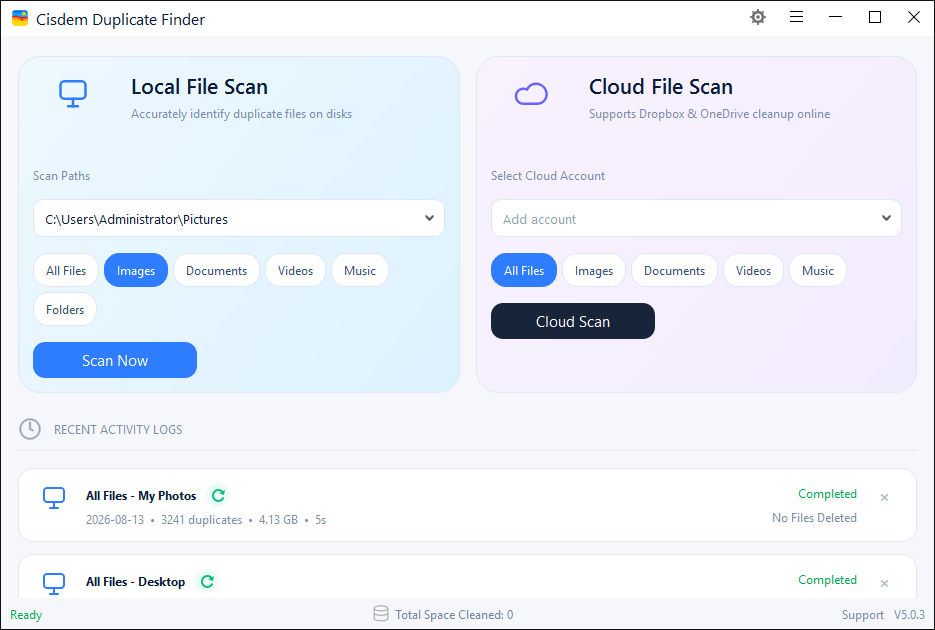
Step 1: Scan

Add one or more photo folders or drives, or a cloud drive account containing your photos, then click the Scan button.

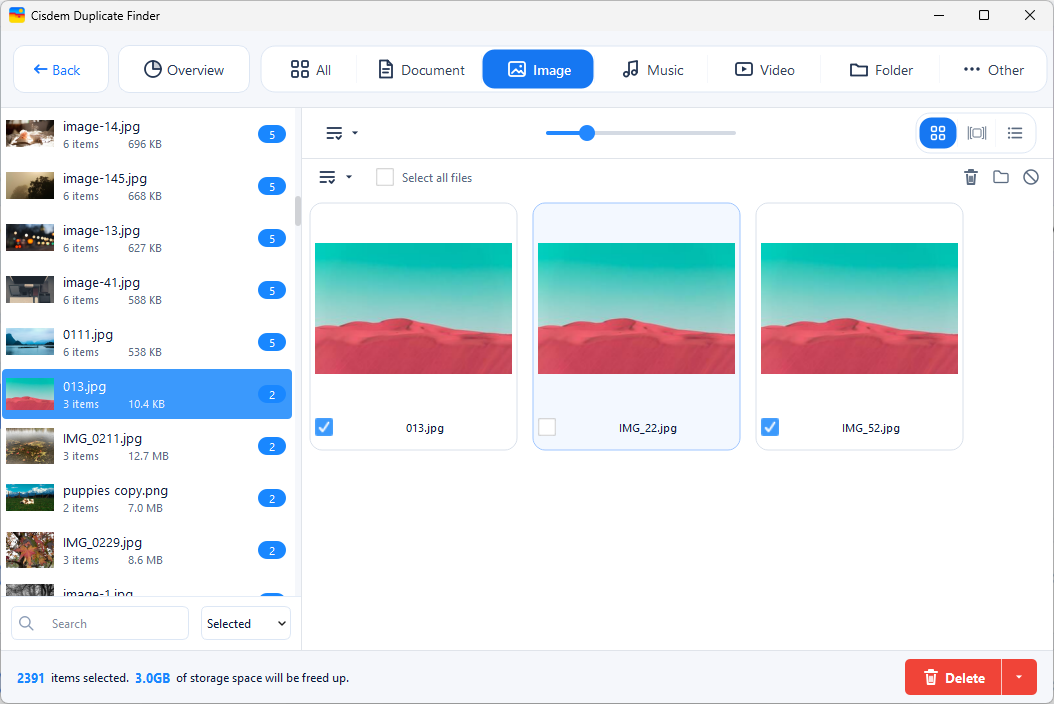
Step 2: Review

When the scan is complete, the results window displays duplicate and similar photos for you to preview, sort, and search.

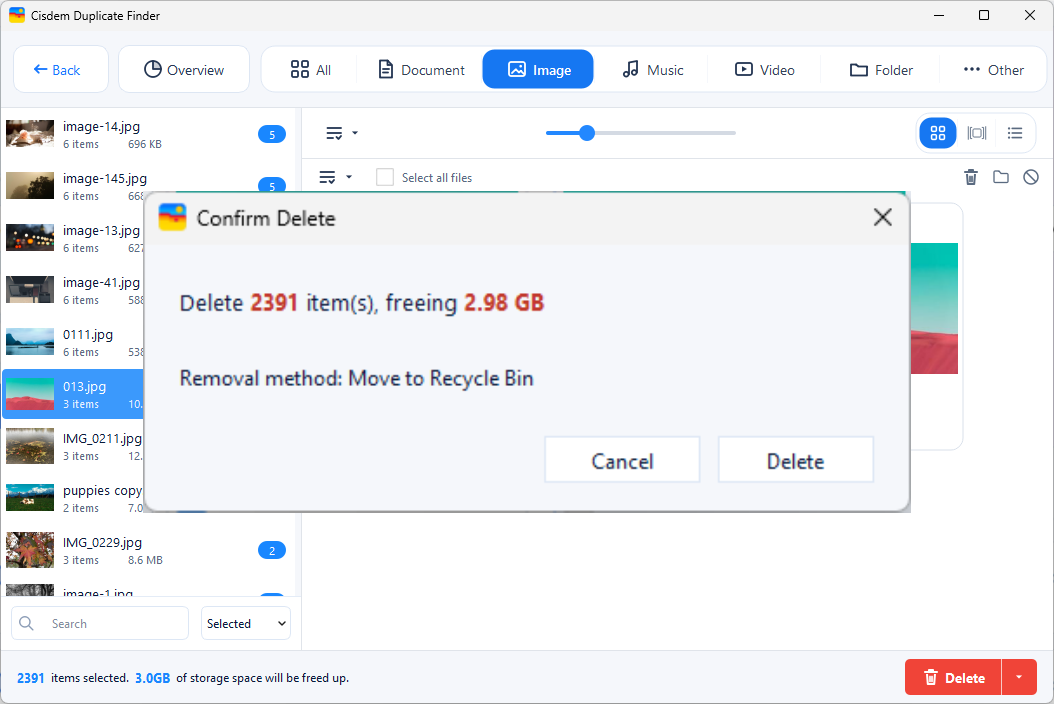
Step 3: Delete

Select unwanted duplicates and similar photo versions with the help of selection rules. Click Delete and confirm the action to move all selected photos to the Recycle Bin (Windows) or Trash (Mac).

Step 1 Step 2 Step 3