


The Best Way to Find Duplicate Images of Different Sizes
 1.4K
1.4K
 3
3


Key Takeaway
It's common to have duplicate photos with unique sizes, and you can remove unwanted versions if needed. Luckily, there's a way to detect such duplicates automatically and help you bulk delete unwanted versions.
There are exact duplicate images (exactly identical regardless of their file names). There are also non-exact duplicate images, such as photos that look the same to the naked eye but have different sizes. If some of your photos have two versions, one in a bigger size and the other smaller, you may want to remove the unwanted versions.
This article shows you how to find duplicate images of different sizes in an easy way on Windows PC and Mac. The identification is automatic, and the removal is easy, quick, and reliable.
 Cisdem Duplicate Finder
The Best Duplicate Image Finder
- Identify exact duplicate photos along with all other duplicate files (videos, audio, etc.)
- Identify duplicate photos of different file sizes, resolutions, or formats
- Detect similar-looking photos too
- Support Windows PC, Mac, external storage devices, cloud drives, and more
- Find duplicates in folders, Mac's Photos, iTunes, and Apple's Music
- Let you view duplicates in 3 ways, with side-by-side image previews
- Automatically select all but one file for deletion in each set of exact duplicates
- Allow you to select files manually or choose from 8 rules (e.g., Select Newest, Select Smallest)
- Easy to use and customize


3 things to know
Knowing these things can help you better understand and deal with such duplicate photos.
- The size of an image can refer to the file size, which is how much storage space this image takes up and measured in KB or MB. Also, it can refer to the pixel size, which is the pixel counts (often referred to as resolution) of this image and measured in pixels (such as 3120 x 4160). The pixel size can determine the file size and quality.
 |
|
|
|
| Pixel size | 1600 x 1067 | 800 x 534 | 400 x 267 |
| File size | 1.4 MB | 718 KB | 136 KB |
- Why do you have duplicate images in different sizes? There can be various reasons, such as compressing the file size, reducing the resolutions (like from 3120 x 4160 to 1560 x 2080), converting the format (like from JPG to PNG), and importing both the HEIC and JPG versions of your photos from iPhone.
- In a set of such duplicates, which photo should you keep? Ideally, you may want to keep the original one, which generally has the highest resolution and file size. If one version is in JPG and the other in HEIC or RAW, choose the desired format to keep or keep both. (HEIC offers the same visual quality as JPG does but use less storage space.) You may need the RAW image for post-processing. All in all, it depends on you.
How to find duplicate images of different sizes
There is more than one method available, and using Cisdem Duplicate Finder can be the best method due to the following benefits:
- Automatically identify duplicate images, whether they are exactly identical (regardless of their file names) or have different resolutions, file sizes, or formats
- Find photos that look similar too
- Allow you to conveniently preview photos and see photo information
- Automatically select all exact duplicates for one-click removal while keeping original photos unselected (hence untouched)
- Offer rules to help you mass select duplicates for deletion by resolution, file size, time, and more
- Allow you to manually adjust selections
- Help you find duplicates on Windows PC, Mac, external hard drive, SD card, Google Photos, OneDrive and more, including those in the Photos app on Mac and Windows PC
Step-by-step instructions
Step 1. Install duplicate image finder software
Download and install Cisdem Duplicate Finder. Open it.
 Free Download Windows 10 or later
  Free Download macOS 10.11 or later
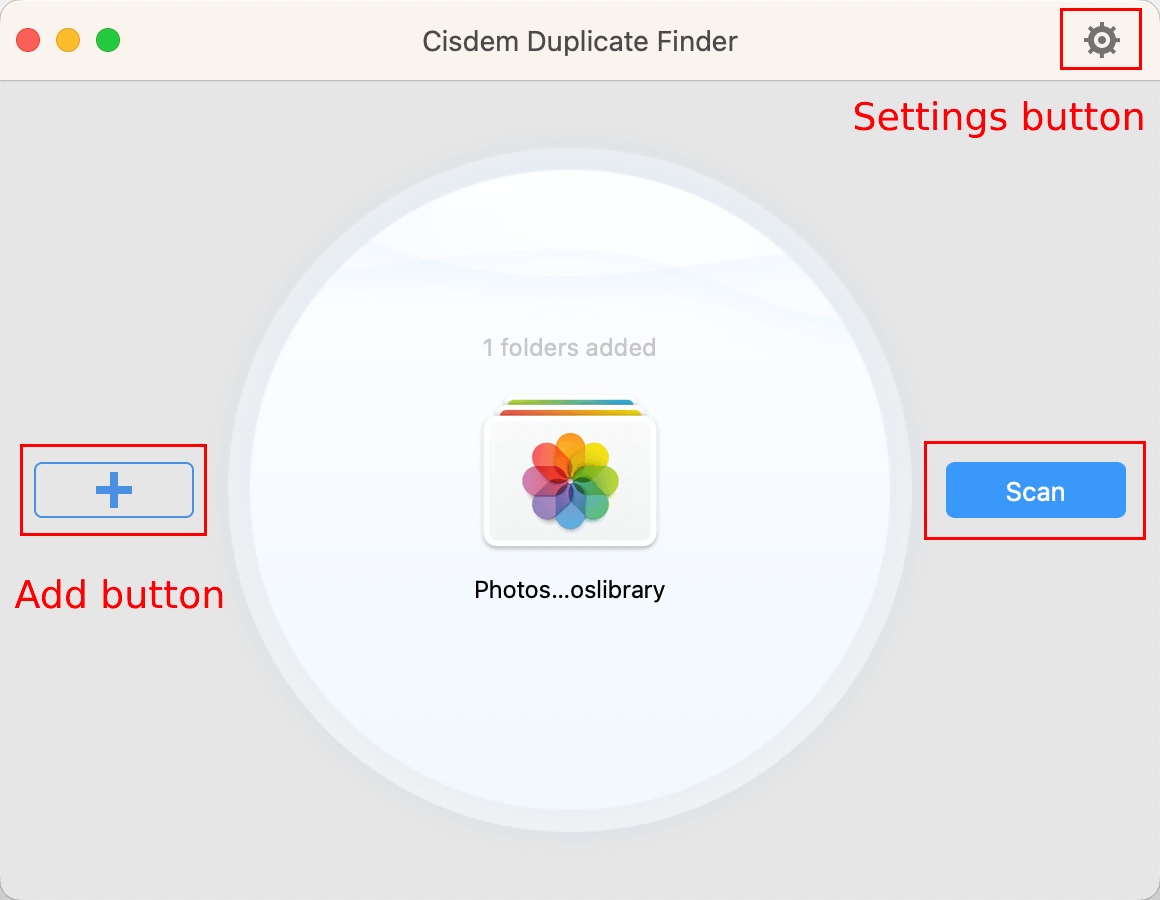
Step 2. Add the location to find duplicate images
Use the Add button or drag and drop to add one or multiple folders from your computer, external storage device or cloud storage service. You can also add Mac’s Photos or Windows’ Photos.
Step 3. Customize settings
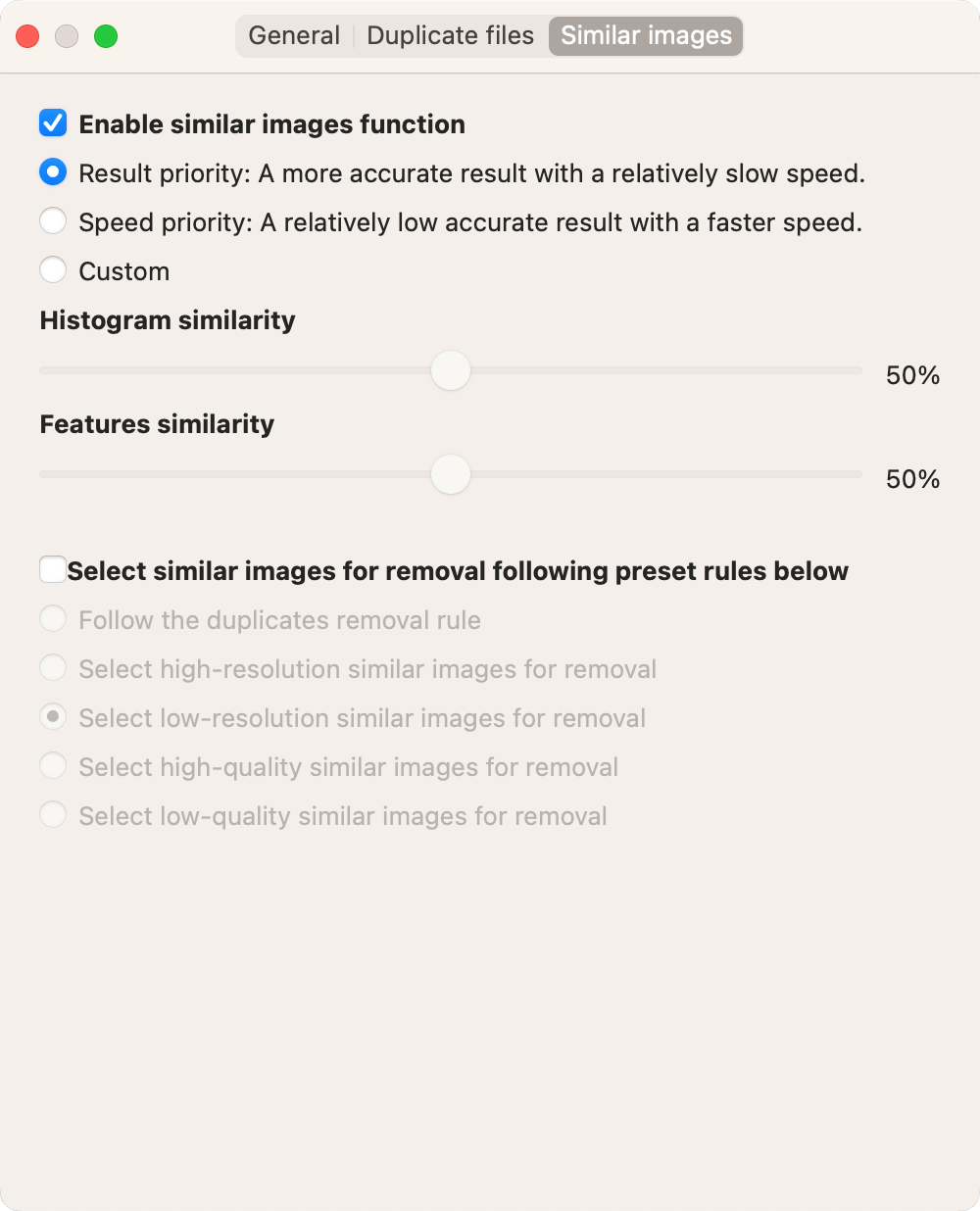
Click the Settings button to open the Settings window. Go to the Similar images tab to select the Enable similar images function checkbox.
Step 4. Click Scan
Click Scan on the right to start scanning for duplicate images.
Step 5. View duplicate images
When the scan is complete, you’ll see the results window.
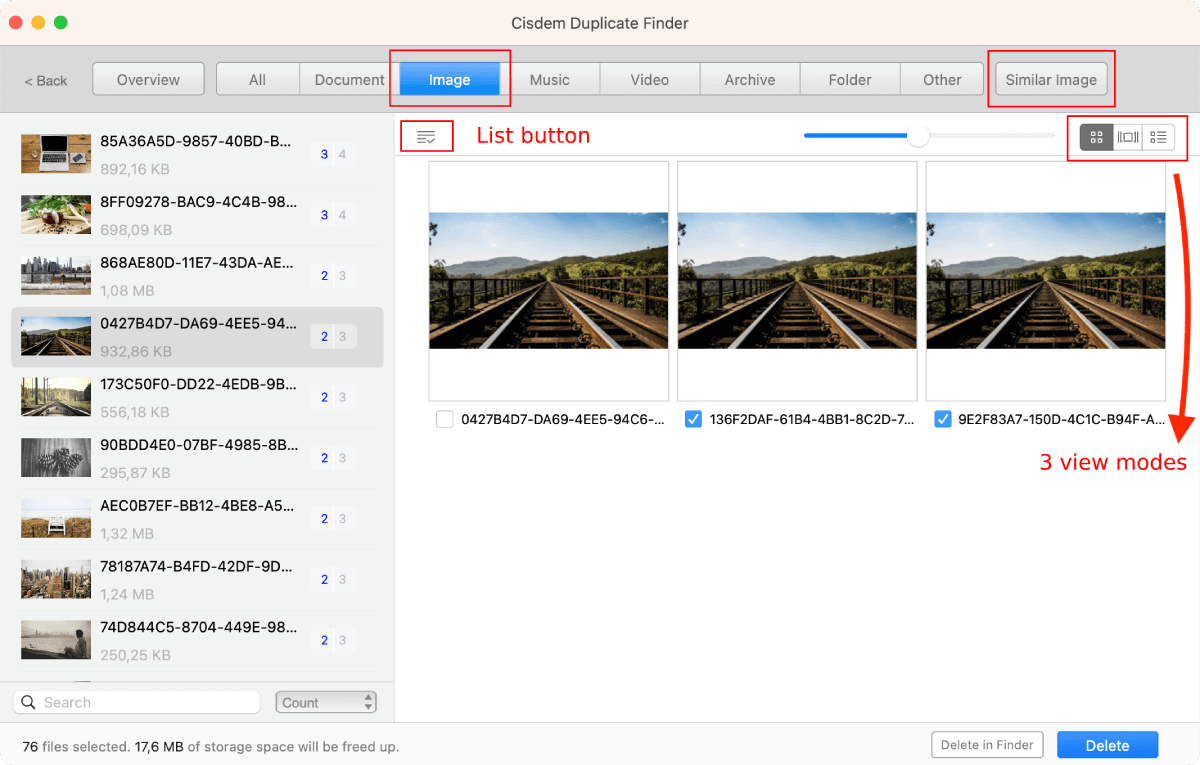
- On a Mac, the Similar Image tab displays duplicate images of different sizes (and similar-looking images if any). (The Image tab displays exact duplicate images.)
- On a Windows PC, the Image tab displays exact duplicates at the top, followed by duplicates that have different sizes. (You may need to scroll down.)
![Similar Image tab of the results window showing a few sets of duplicate photos]()
Step 6. Select unwanted versions of duplicate photos for deletion
In each set of duplicates, you can manually select the unwanted version(s) for removal.
If you want to bulk select, just highlight the sets (on the left) to which you want to apply a selection rule, click the List button, and choose a desired rule. For example, choosing the Select Smallest rule will automatically keep the photo with the largest file size in each set and select the rest for removal.
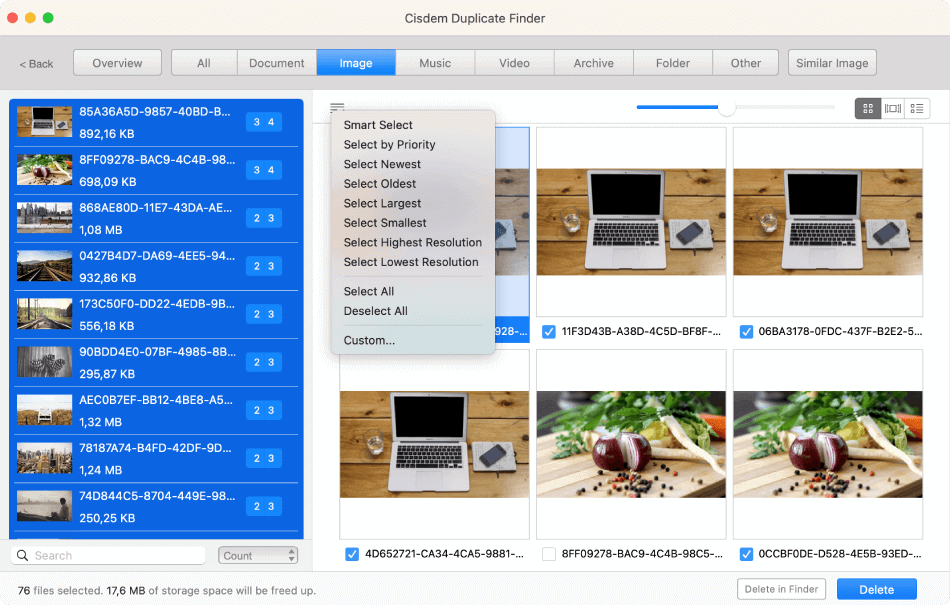
Step 7. Delete all unwanted versions with a click
To delete all selected versions at once, just click Delete in the bottom right corner, then confirm the deletion.
The deleted duplicate photos will go to the Recycle Bin on Windows PC, or Trash on Mac, or wherever the deleted files typically go.
Tip
If you are not satisfied enough with what you see in the results window in step 5, just go to the Similar images tab to adjust the settings and then scan again.
Conclusion
Sometimes you compress a bunch of photos to send via email. Sometimes you convert some photos to a certain format to be able to upload them somewhere. This may be how you end up having different sized versions of the same photo. You generally don’t actually need two versions of the same photo.
If many of your photos have multiple versions, you can get rid of redundant versions to improve organization and free up storage space. This article shows you an easy, quick way to find duplicate images of different sizes and remove redundancy. I hope it’s helpful.

With a passion for tech and writing, Sarah joined Cisdem, where she focuses on creating articles about using utility tools to enhance file management and simplify contact management.

Adrian Li is Cisdem’s Chief Engineer and serves as the editorial advisor for Duplicate Finder and ContactsMate. His work and insights have been featured in leading tech publications such as Fossbytes, TUAW, Redmond Pie, SafetyDetectives, and BestForAndroid.
Harper Wright
Great article. I was struggling with duplicate photos on my computer. The methods in this guide made it much easier to find and remove them. Saved me a lot of time.
Hella Schmitt
Thank you! I moved over 2k photos from my computer and 1.5k were near-duplicate photos of different file sizes. Good tool!
Jodok Batlogg
Exactly what I was looking for. Easy to use. Thank you!