


How to Block Websites on Windows 10/11 in All Browsers: 5 Ways
 19.6K
19.6K
 4
4


No matter you are looking to block websites on Windows 10 or 11 for productivity, parental control, or a different purpose, you will find this article helpful. In the article, I'll share five methods.
And for each method, I will cover:
- The pros and (potential) cons of the method.
- A step-by-step guide on how to block websites using the method.
This will help you easily find the method that best suits your needs.
 Cisdem AppCrypt
The Best Website Blocker for Windows
- Block websites in Chrome, Edge, Firefox, and more with a password
- Block specific sites and pages, URLs with certain keywords, and categories of sites (e.g., Porn, Gambling, and Social)
- Also block all websites except the ones you allow
- Lock apps with a password
- Block websites and lock apps 24/7 or at scheduled times
- Easy to use
- Hard to bypass
- Restrict website access for your children or yourself
- Help with parental control, productivity, and privacy protection


Method 1. Block websites on a Windows 10 or 11 computer using AppCrypt
Compatibility: Windows 10 or later
Supported browsers: Chrome, Edge, Firefox, Opera, and Brave (With an option to lock unsupported browsers)
Suitable for: Users who are looking for an easy and effective way to restrict website access
This method uses Cisdem AppCrypt, a website blocker and app lock in one. It's easy to use for everyone, helping you effortlessly control access to websites for your children or yourself. Password protection makes blocking hard to circumvent.
Pros
- Let you add specific websites, pages, and keywords to the block list
- Let you block websites by category (e.g., Porn and Social)
- Offer an option to block all websites except allowed ones
- Allow you to block websites permanently or during scheduled hours (e.g., 9:30 AM to 5:30 PM)
- Protect blocking with a password and other measures
- Can be used for children and adults
Cons
- Incompatible with Windows 7 or earlier
The steps below show you how to use this method.
1. Download and install AppCrypt on your or your child's PC. It's compatible with Windows 10 and 11.
 Free Download Windows 10 or later
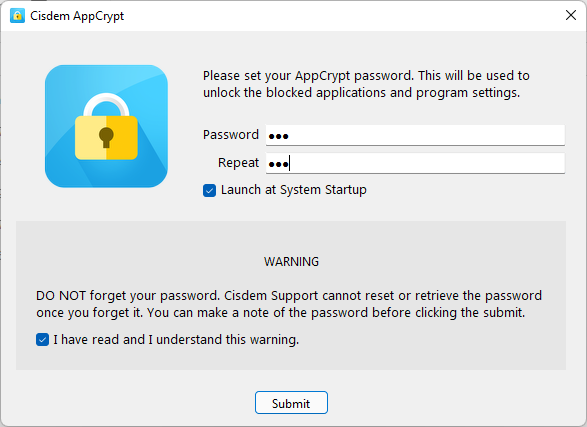
2. The first time you open it, set a password.
Note
If you want to prevent your own access to websites effectively, you can ask someone else to set the password for you.
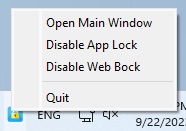
3. Click its icon in the taskbar. (Alternatively, click the icon and choose Open Main Window.)
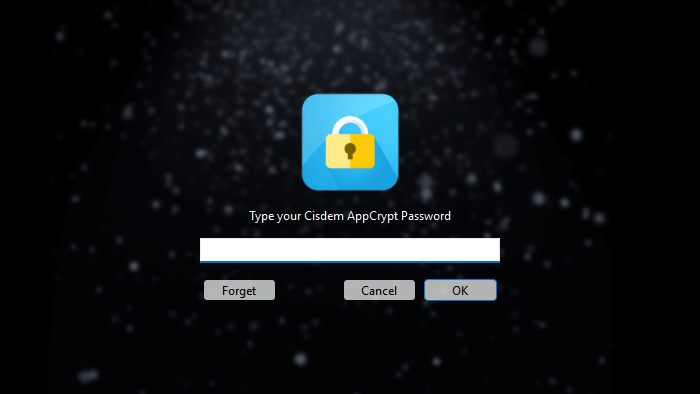
4. Enter the password (set in step 2) to access the main window.
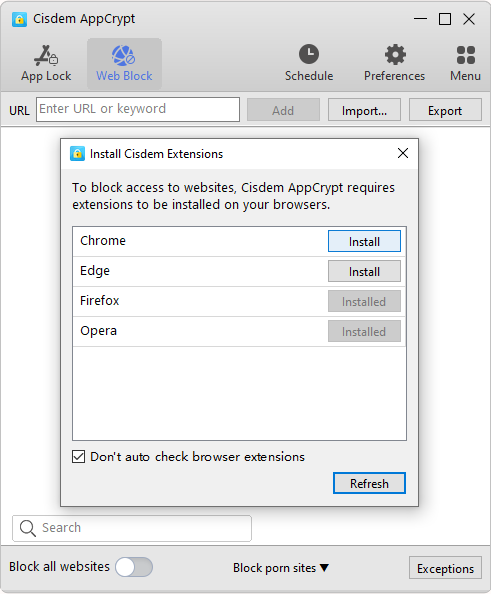
5. In the main window, click the Web Block tab. Install the extension on your chosen browser(s) when prompted.
Note
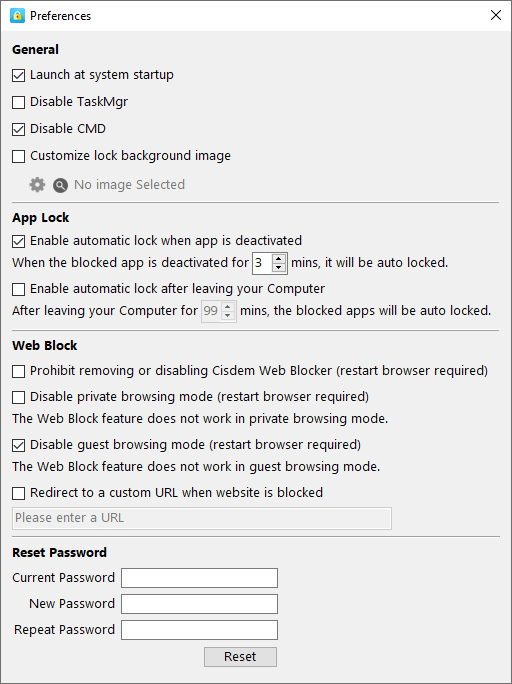
Go to "Preferences" and select the first three checkboxes in the "Web Block" section. This prevents the extension from being removed or turned off (and also prevents other possibilities of bypassing).
6. Do any of the following:
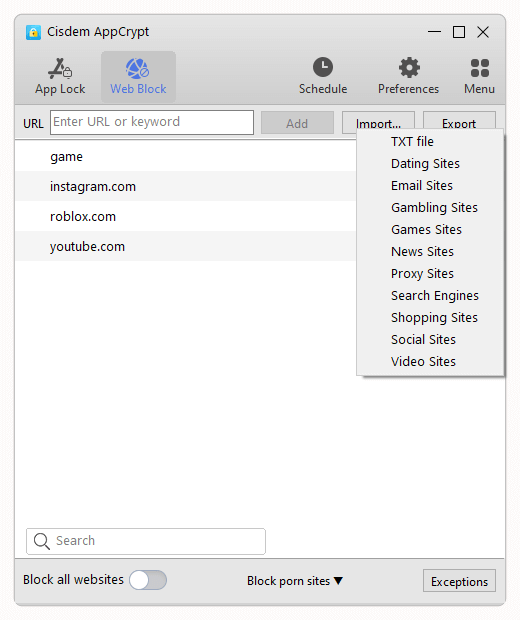
- Add a specific website (e.g., youtube.com) to the URL field and click Add. Continue adding other unwanted sites to the block list.
![Web Block tab showing a list of four websites, a list of ten website categories, a Block porn site feature, and more]()
- Add specific keywords to the block list to block URLs that contain them.
- Click Block porn sites at the bottom of the interface and choose Always Block to block all porn sites.
- Click Import and choose a category to block popular sites in this category (or import your own list of websites).
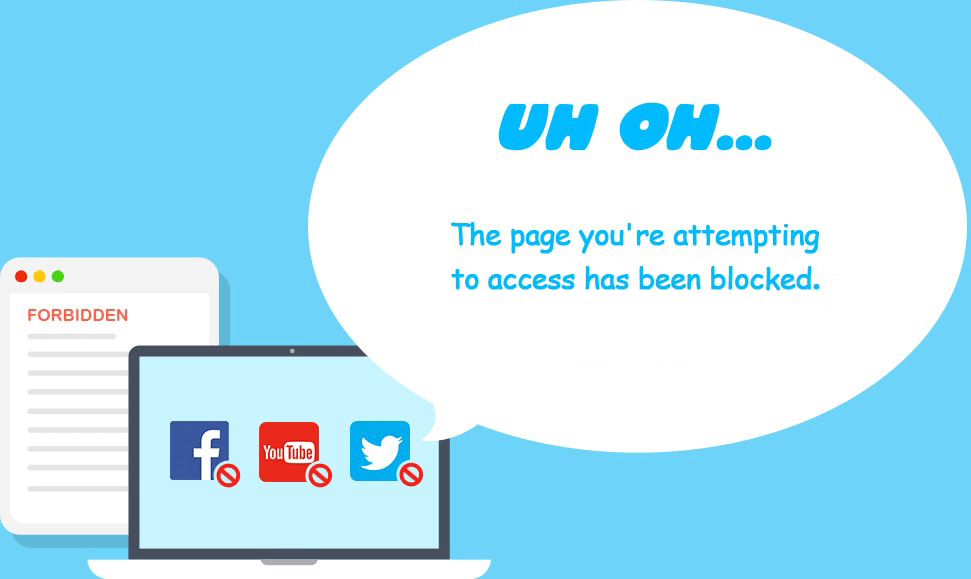
Now all the unwanted websites are blocked on this PC.
Tip 1
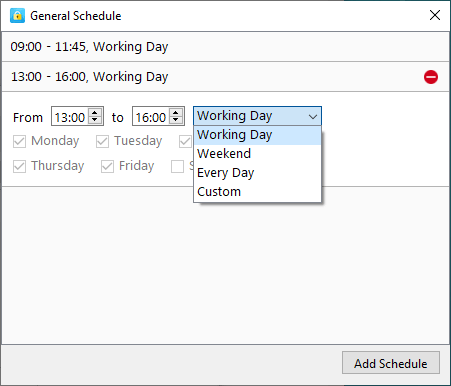
By default, those websites are blocked permanently. But there's a schedule feature to provide flexibility. For example, you can set distracting websites to be restricted only during work hours. (I recommend blocking adult sites and other inappropriate sites at all times, especially for children.)
Tip 2
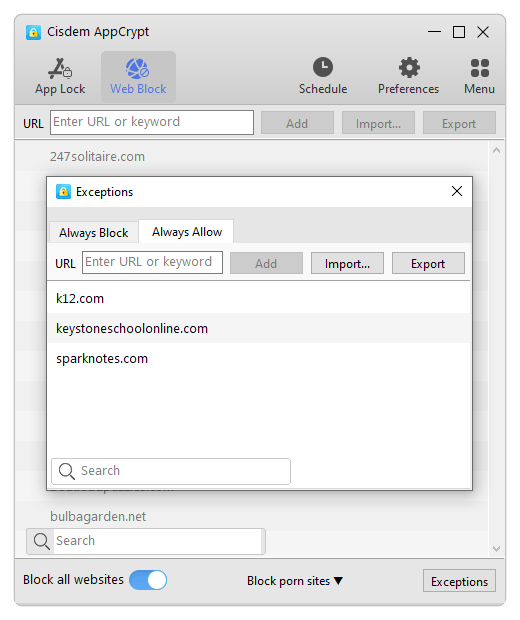
If you want an extremely distraction-free or child-safe environment, you can allow access to certain websites only. Here's how. Turn on Block All Websites, click Exceptions, and add specific sites to the Always Allow list.
Method 2. Use BlockSite to block websites in Chrome, Firefox, and Edge
Compatibility: Windows 10 or later
Supported browsers: Chrome, Firefox, and Edge
Suitable for: Users who need a barrier against unwanted websites but don't need a very hard-to-bypass solution
This method uses BlockSite, a browser extension. Like the website blocker used in the first method, it's easy to use and feature rich. For example, it has a schedule feature, a whitelist feature, and even a Focus mode to manage focus time and breaks.
Note
As mentioned, the first method also involves installing a browser extension, but that extension can't be turned off or removed due to the Preferences configuration. However, BlockSite can be turned off or uninstalled by anyone. Therefore, one can easily unblock websites.
Pros
- Block specific websites
- Filter URLs containing specified keywords
- Block websites by category (e.g., Adult and Social)
- Provide a Whitelist mode to block all sites except a few
- Let you schedule blocking
Cons
- Can be easy to bypass
(BlockSite does have password protection, which, when enabled, prevents access to its configuration page. This way, only people who know the password can do things like editing the block list. However, the protection doesn't stop people from disabling or uninstalling the extension itself.)
Below are the steps.
1. Go to the extension store (e.g., Chrome Web Store) for your browser. Search for and install BlockSite.
Note
If you need to restrict website access in multiple browsers on this Windows PC, you need to install and set up the extension for each browser individually. And the steps are basically the same.
2. On a random web page, click the BlockSite icon on the browser toolbar. Click the gear icon that appears.
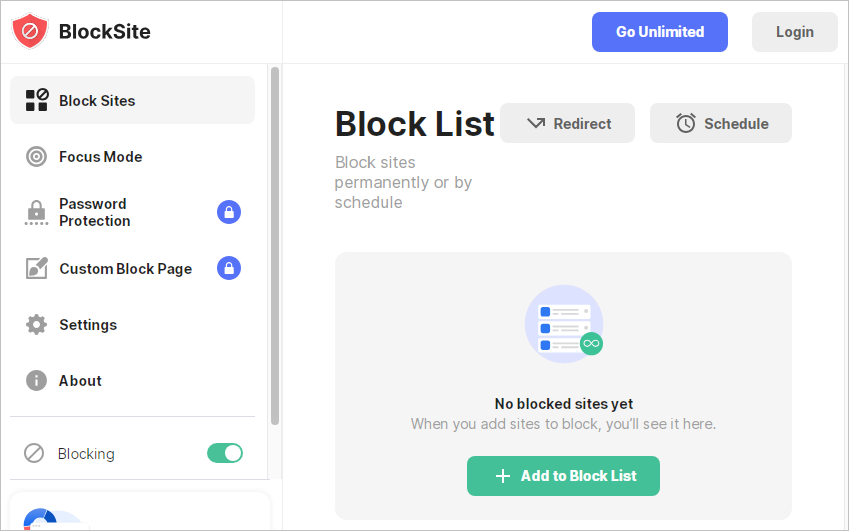
3. Now you are on the configuration page. Click the Block Sites tab on the left. Click Add to Block List.
4. Do any of the following:
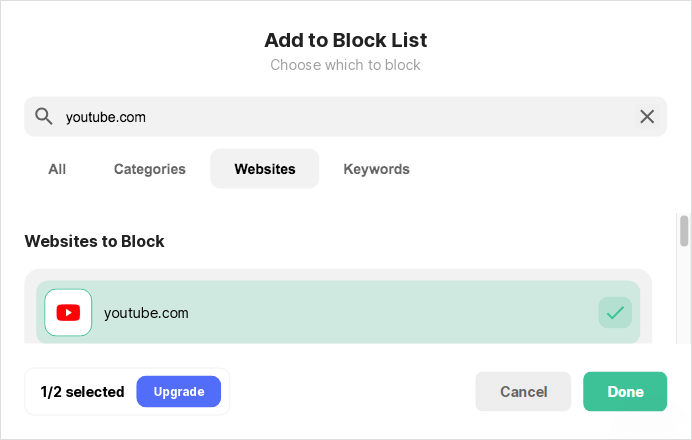
- In the Websites tab, enter a specific unwanted website in the box at the top. Once the site appears on the list below, click the add icon next to it. Now it's on the block list.
- In the Keywords tab, add unwanted keywords one by one. URLs that include a blocked keyword will be blocked.
- In the Categories tab, block a website category by clicking the add icon next to it.
5. Click Done.
6. Optionally, if you want, you can enable password protection, set a password, and provide your email address.
The websites you've specified will be blocked on this browser all the time as long as the extension is actively working. If you try to open a blocked site, it won't open, and instead you will see a playful message telling you that access is blocked.
Tip
Both the Schedule feature and the Whitelist mode are in the Block Sites tab (as in step 3). You can easily set up schedules and add websites to allow as needed.
Method 3. Apply blocking to all browsers on Windows PC along with other devices by configuring router settings
Compatibility: All Windows versions
Supported browsers: All browsers
Suitable for: Users who have access to the router settings, for example, a home router
If your home router has a parental controls or web filtering feature and you are restricting websites on a PC used mostly at home, it will be a good idea to implement restrictions by configuring your router settings.
Pros
- Allow you to block websites by URL, keyword, or even category (depending on the router used)
- Apply blocking to all browsers, operating system versions, and devices, not just Windows
Cons
- Blocking will stop work if a VPN is used, or if your PC uses a different Wi-Fi
Here I use my router (TP-Link BE24000) as an example to show you the steps.
1. Open your router settings page by visiting 192.168.1.1 or 192.168.0.1 in a browser. (It's 192.168.0.1 in my case.)
2. Log in with your username and password or just a password, depending on your router.
Tip
If you haven't logged in before and don't know the login information, just check out the back of your router.
3. Go to HomeShied > Parental Controls.
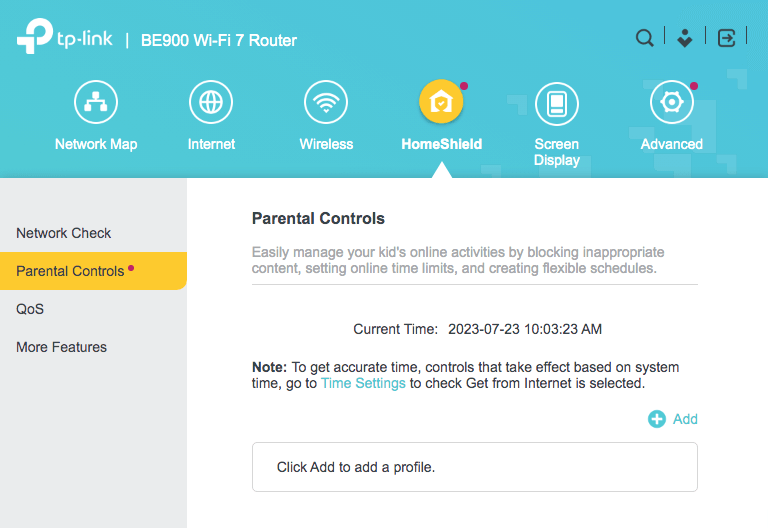
4. Click the Add button to create a profile and give it a descriptive name, such as Tom's PC. Then, click Add Devices to select the specific Windows PC from the device list. (All devices ever connected to this Wi-Fi appear on the list.)
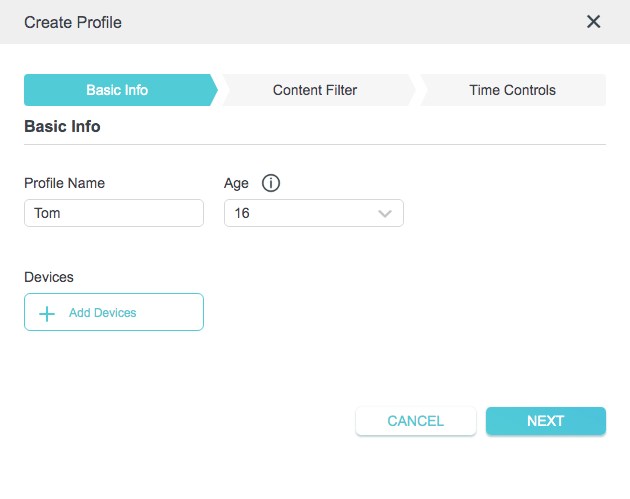
5. Click Next to continue.
6. Select unwanted website categories and add unwanted websites.
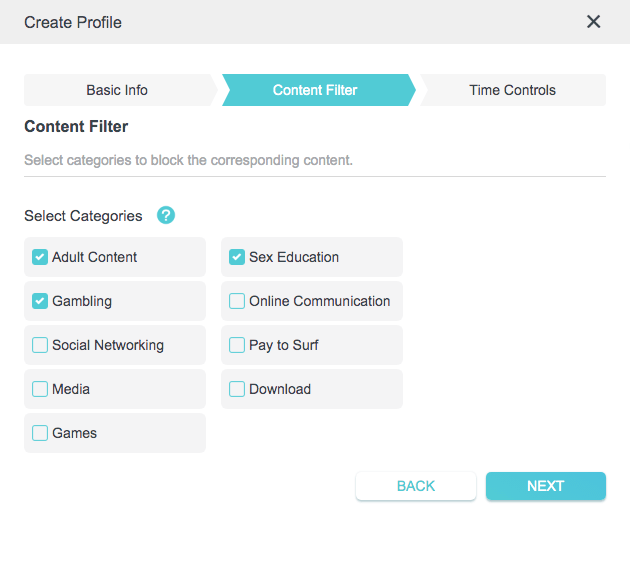
7. Save your settings.
From now on, whenever this PC is connected to this Wi-Fi, specified websites will be blocked and inaccessible on all installed browsers.
Note
If your router doesn't allow you to create profiles or select devices, blocking will apply to all devices connected to it.
Method 4. Block a website in all browsers on Windows by editing the hosts file
Compatibility: All Windows versions
Supported browsers: All browsers
Suitable for: Tech-savvy users with a short list of websites to block
Every Windows computer has a hosts file, which is a system file. This method involves editing the hosts file using the built-in Notepad app.
If you are tech-savvy and only need to block a few sites, you can consider the method. If you don't know much about computers but still want to try it, I recommend learning about the hosts file first and taking caution during editing.
Pros
- Block specific websites
- Apply blocking to all browsers
- Built-in to Windows
Cons
- Take time and patience to add websites to block
- Websites unblocked automatically when a VPN is used
You can follow the steps below.
1. On your PC, find Notepad and run it as an administrator.
2. In the File menu, click Open.
3. Navigate to the hosts file and open it. The hosts file is typically located in Local Disk(C) > Windows > System32 > drivers > etc.
4. Place the cursor at the bottom line and start adding websites to block.
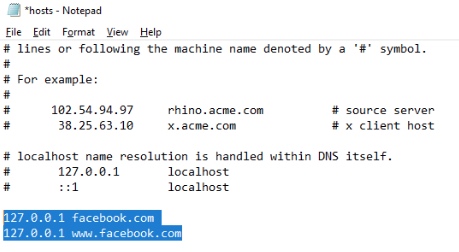
For example, to block facebook.com, add the following two lines.
127.0.0.1 facebook.com
127.0.0.1 www.facebook.com
Add other unwanted sites following the same format.
5. In the File menu, click Save.
Now these websites are permanently blocked in all browsers on this Windows computer. One will see a “can't reach this page” message when one tries to open a blocked site.
Note
If your browser still loads certain blocked websites, don't worry. It's due to the browser cache. You can clear cache if needed.
Method 5. Block websites for Windows 10 or 11's non-administrator accounts using Microsoft Family Safety
Compatibility: Windows 10 and 11
Supported browsers: Edge
Suitable for: Parents who want to restrict website access for their children using standard accounts
Note
Windows 10 and 11 allow users to create and use two types of accounts on a computer: the administrator ones and the standard (non-administrator) ones. This method only applies to standard accounts. If your child really needs to use an administrator account, then this method isn't your choice.
It's a method coming from Microsoft and uses Microsoft Family Safety (or simply Family Safety). Although Family Safety blocks websites only on Edge, it disables other browsers. In addition to controlling website access, Family Safety provides other parental controls and can be a helpful tool for parents.
Pros
- Block specific sites
- Restrict inappropriate websites with a click
- Provide a way to block all sites except those allowed ones
- Built-in to Windows 10 and 11
Cons
- Only work with standard accounts on Windows
- A bit complex to set up
Make sure that you and your child both have Microsoft accounts and then follow the steps.
1. Sign in to your Microsoft account.
2. Go to https://account.microsoft.com/family/home.
3. Click Add a family member.
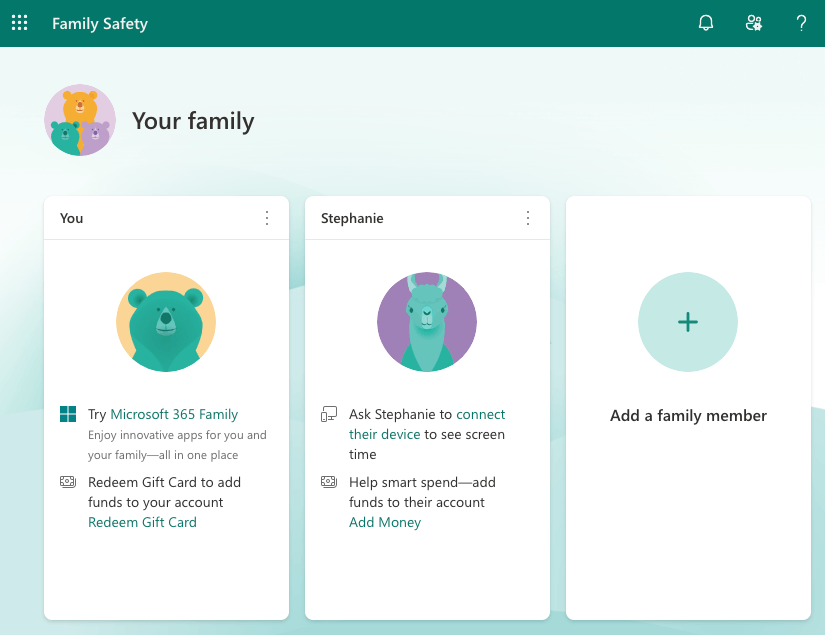
4. In the dialog that appears, click Members and then Next, enter your child's Microsoft account, and click Invite.
5. Sign in to your child's Microsoft account. (You can use a different browser for convenience's sake.) Open the invitation email that has just been sent. Click Accept Invitation. On the new page that appears, click Join now.
If you go back to your own account, you will find your child's profile added.
7. Now connect your child's device by logging in to the Windows PC using his or her standard account.
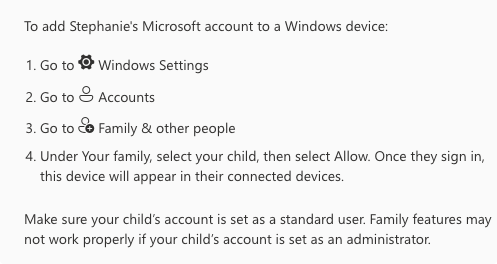
8. Click your child's profile picture and go to the Edge tab.
9. Turn on the Filter inappropriate website and searches option.
10. Go to the Blocked sites section, add unwanted websites to the Blocked sites list one by one.
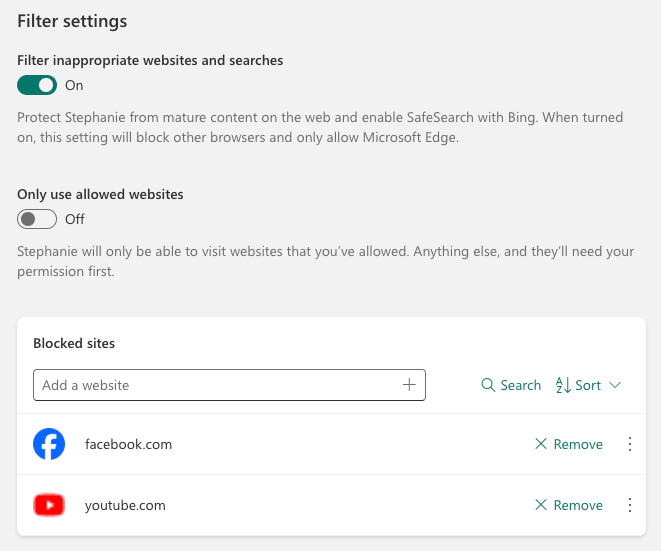
From now on, your child's won't be able to open blocked sites in Edge on the PC when he or she is logged in to this standard account.
Tip
If you want to strictly control what your child can access online, you can turn on the Only use allowed websites mode to allow approved sites while blocking all the rest sites.
FAQs
How do I block certain websites on Windows 10?
To block all sites, you can simply turn off Wi-Fi. However, blocking specific sites is not that easy. You need to use a website blocker (methods 1, 2, and 5) or configure the internet settings (methods 3 and 4).
How do I block all unwanted websites?
No method can help users completely block all unwanted websites (so far). That being said, you can make use of features, like blocking websites by category or the whitelist (or allowlist) mode, to block as many as unwanted sites as possible. These features are covered in the article.
How do I permanently block websites?
All the methods discussed in the article provide permanent website blocking by default. This is unless you use a schedule feature (if available) to set the blocking on or off.
How do I block websites on my child's computer?
You can install and set up a website blocker on your child's computer or configure the internet settings on this very device. If the method you use has password protection to prevent bypassing blocked sites, it's important that you set a strong, hard-to-guess password.

Norah Hayes likes to share her tips on how to improve focus and stay motivated at work. She believes it is essential to eliminate all online distractions during work hours.

Ethan Long joined Cisdem in 2015 as a developer and now serves as the editorial advisor for Cisdem AppCrypt. He actively tests and uses Cisdem AppCrypt and other screen-time management tools to ensure AppCrypt meets its promises in real-world scenarios.
Chloe Garcia
I use both Chrome and Edge, so I wanted a way to block distracting sites in both. This guide made the options easy to understand. Thanks.
Vivian Liana
I was looking for a way to block distracting websites on my Windows PC during work hours. This article helped me. AppCrypt is exactly what I needed. Thanks!
Derik Stenerson
The hosts file method is free, but a bit complicated. And in my experience, some sites can't be blocked by it. Method 1 works perfectly. Thanks!
Ivan Chevillote
Thanks, now I can stop my addiction to bad websites.