


Cisdem Document Reader User Guide
 4.6K
4.6K
 0
0


Cisdem Document Reader is a powerful document viewing solution that helps you open, read, and manage various document formats in one application.
Instead of installing multiple programs for different file types, you can access dedicated readers for:
- PST
- Winmail.dat
- DjVu
- XPS/OXPS
- Visio
- WPD
- DXF/DWG
Download & Install
1. You can download the installation package from the link below.
 Free Download
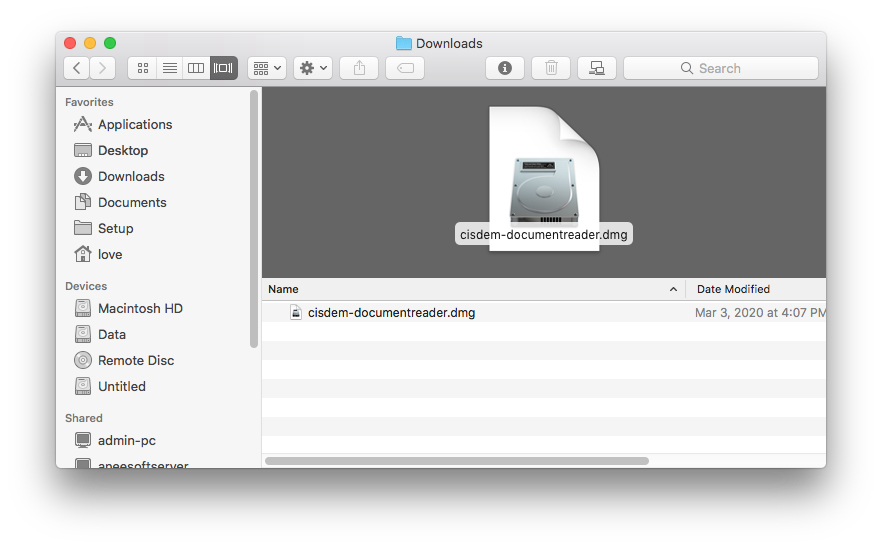
2. Install Cisdem Document Reader with the downloaded package.
Double-click the .dmg file.
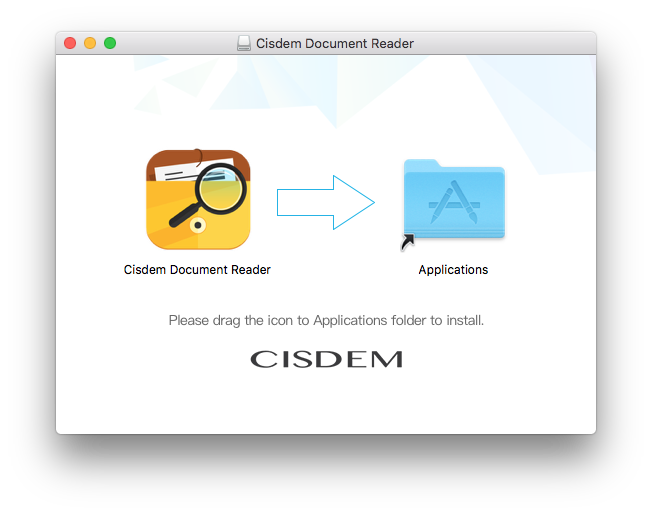
Drag the Cisdem Document Reader icon to Applications folder.
Activate
Cisdem Document Reader uses a flexible module-based purchase system. You can purchase only the Reader or feature module you need.

To activate:
- Launch Cisdem Document Reader.
- From the Home screen, click the desired document format to access its dedicated section.
- Click the Key icon in the upper-right corner of the window.
- Copy and paste your license code into the activation window.
- Click Activate.
Open Files
You can open documents in several ways.
Method 1: Open from the App
- Launch Cisdem Document Reader.
- Select the required Reader.
- Click the Open button on the toolbar.
- Select one or more supported documents.
- Click Open.
Method 2: Drag and Drop
Drag supported files directly into the Cisdem Document Reader window.
The files will open automatically in the corresponding Reader.
Method 3: Open from Finder
You can also open supported files directly from Finder.
- Locate the file in Finder.
- Right-click the file.
- Select Open With.
- Choose Cisdem Document Reader.
Method 4: Open from Menu bar
Click File > Open/Recent files or simply press shortcut keys CMD+O, choose files from Finder.
View and Manage Documents
Cisdem Document Reader provides a comfortable reading experience with multiple viewing and navigation options.
1. Different View Modes

Single Page View
Single Page View displays one page at a time, allowing you to focus on the current page while reading documents.
To enable Single Page View, click  on the toolbar.
Two Page View
Two Page View displays two pages side by side, providing a book-like reading experience. It is especially useful when reviewing documents with continuous page layouts.
To enable Two Page View, click  on the toolbar.
Thumbnail View
Thumbnail View displays small previews of document pages, allowing you to quickly browse and navigate through the file.
To use Thumbnail View:
- Click the
 on the toolbar.
 - The thumbnail panel will appear.
- Select a page thumbnail to jump directly to that page.
Full Screen View
Full Screen View removes unnecessary interface elements and provides a distraction-free reading experience.
To enter Full Screen View, click Full Screen on the toolbar. The document will expand to fill your screen.
2. Zoom Documents
You can adjust the document size to view content more clearly. Cisdem Document Reader provides several zoom options:
- Zoom In
- Zoom Out
- Actual Size
- Zoom to Fit

Zoom In and Zoom Out
Use the zoom controls to enlarge or reduce the document view.
This is useful when reading small text, reviewing detailed drawings, or checking document layouts.
Actual Size
Actual Size displays the document at its original size based on its actual dimensions.
This mode is useful when you need to view content at its original scale or inspect detailed document elements.
Zoom to Fit
Zoom to Fit automatically adjusts the document size so the entire page fits within the application window.
This mode is useful when you want to view the complete page at once or quickly adjust the view after resizing the application window.
3. Navigate Pages
Cisdem Document Reader provides multiple ways to move through documents.

You can navigate pages using:
- Previous Page
- Next Page
- First Page
- Last Page
- Scroll navigation
- Thumbnail navigation
Use the navigation buttons on the toolbar or select a page directly from the thumbnail panel.
4. Rotate Documents
Cisdem Document Reader allows you to rotate documents for a more convenient viewing angle.

To rotate a document, directly click the correspoding clockwise or counterclockwise rotate buttons on the toolbar. You can rotate the current page or all pages, depending on the available options.
Rotation is useful when viewing scanned documents, drawings, or pages with different orientations.
5. Search Document Content
The search feature helps you quickly find specific words or phrases inside supported documents.

To search content:
- Enter a keyword or phrase in the search bar.
- Press Return to search.
- Browse through the search results to locate the content you need.
Matching content will be highlighted, allowing you to quickly locate important information.
6. Use Bookmarks
Bookmarks allow you to save important pages and return to them quickly.
Add a Bookmark
- Open the page you want to save.
- Click
 .
. - Name the current page and click Add, this page will be added to your bookmarks.
Access Bookmarked Pages
- Click Bookmarks on the menu bar.
- Select Manage Bookmarks.
- Select a bookmark.
- Click Open to jump directly to the saved page.
Bookmarks are useful for:
- Frequently accessed pages
- Important sections
- Reference documents
7. Use Multi-Tab View
Cisdem Document Reader supports opening multiple documents in different tabs, making it easier to work with several files at the same time.

With multi-tab view, you can:
- Open multiple documents simultaneously
- Switch between files quickly
- Compare information between documents
To open another document, simply open it while Cisdem Document Reader is running. The document will appear in a new tab when supported by the Reader.
8. Print Documents
Cisdem Document Reader allows you to print supported documents directly from the application.

To print a document:
- Open the document.
- Click
 .
. - Select your printer settings.
- Click Print.
Use PST Reader
Open PST Files Without Outlook

PST Reader allows you to open Outlook PST archives without installing Microsoft Outlook.
You can view:
- Emails and attachments
- Calendar
- Contacts
- Journal
- Notes
- Tasks
PST Reader preserves the original mailbox structure, making it easy to browse emails and other information stored in PST files.
Convert PST Files to Other Formats

You can convert PST content into commonly used formats, including:
- Emails (.EML)
- Contacts (.VCF)
- Calendar (.ICS)
- Notes (.TXT)
- Journal (.ICS)
Steps
- Open a PST file.
- Select the content you want to export.
- Click
 .
. - Choose the items you want to convert, then click Convert.
Export PST Files to Other Mac Apps

You can export contacts and calendar events directly to the Contacts and Calendar apps on your Mac.
Steps
- Open a PST file.
- Click
 .
. - Select the items you want to export, then click Export.
User Winmail Reader
Open Winmail.dat Files
Winmail Reader allows you to access the contents of Winmail.dat files.

It can display information such as:
- Recipient
- Sender
- Subject
- Message body
- Attachments
The contents are displayed in their original structure for convenient viewing.
Extract and Save Attachments from Winmail.dat
You can open and save attachments to a location on your Mac.

Steps
- Open a Winmail.dat file.
- Locate the attachment you want to save.
- Right-click the attachment.
- Choose Save As, or Save All Attachments, you can also choose Quick Look or Open to preview the attachments before saving.
- Select the destination folder.
Use DjVu Reader
Open DjVu Documents

DjVu Reader allows you to view DjVu and DjV files while preserving their original formatting.
It is suitable for viewing scanned books, documents, and other DjVu files, including large documents.
Convert DjVu to PDF
You can convert DjVu files to PDF format for easier sharing and improved compatibility.

Steps
- Open a DjVu file.
- Click
 .
. - Enter a name for the created PDF.
- Select a destination.
- Click Save.
Extract Images from DjVu
You can extract images from a DjVu file and save them as image files.

Steps
- Open a DjVu file.
- Click
 .
. - Select a location to save the extracted images.
- Click Open.
Use XPS Reader
Open XPS/OXPS Files
XPS Reader allows you to view XPS and OXPS files while preserving their original styling.

Steps
- Launch Cisdem Document Reader.
- Select XPS Reader.
- Open an XPS or OXPS file.
- Use the viewing tools to navigate and inspect the document.
Convert XPS/OXPS to PDF
You can convert XPS and OXPS files to PDF to improve compatibility and make them easier to share.

Steps
- Open an XPS or OXPS file.
- Click the Convert to PDF button.
- Enter a name for the PDF.
- Select the destination folder.
- Click Save.
Extract Images from XPS Files

You can extract all images from your XPS file with one click.
- Open a XPS file.
- Click .
- Select a location to save the extracted images.
- Click Open.
Use Visio Reader
Open Visio Files
Visio Reader allows you to open Microsoft Visio files without installing Microsoft Visio.
It supports commonly used Visio formats, including:
- VSD
- VSDX
- VDX
You can view flowcharts, diagrams, and other Visio documents while preserving their original layout.
View Visio Documents

- Launch Cisdem Document Reader.
- Select Visio Reader.
- Open a VSD, VSDX, or VDX file.
- Use the viewing tools to navigate, zoom, rotate, search, or bookmark the document.
Convert Visio Files to PDF

You can convert supported Visio files to PDF for easier sharing and compatibility.
- Open a Visio file.
- Click .
- Fill in a name for the created PDF file.
- Choose a destination.
- Click Save.
Extract Images from Visio Files

You can extract all images from your Visio file with one click.
- Open a Visio file.
- Click .
- Select a location to save the extracted images.
- Click Open.
Use WPD Reader
Open WordPerfect WPD Files
WPD Reader allows you to open WordPerfect documents without installing WordPerfect.
It is designed to preserve the original document layout and spacing when viewing WPD files created with different versions of WordPerfect.

Steps
- Launch Cisdem Document Reader.
- Select WPD Reader.
- Open a WPD file.
- Use the viewing tools to read and navigate the document.
Convert WPD Files to PDF
You can convert supported WPD files to PDF for easier sharing and compatibility.

Steps
- Open a WPD file.
- Click the Convert to PDF button.
- Enter a name for the PDF.
- Select the destination folder.
- Click Save.
Extract Images from WPD Files

You can extract all images from your WPD file with one click.
- Open a WPD file.
- Click .
- Select a location to save the extracted images.
- Click Open.
Use DXF Reader
Open DXF Drawings Without AutoCAD

DXF Reader allows you to review CAD drawings without installing professional CAD software.
It supports DXF and DWG files and provides tools for viewing drawing details, including layers and zoom controls.
Measure Areas or Distances in DXF Files

To measure an area or distance:
Measurement tools are useful for quickly checking dimensions and areas in CAD drawings.
Add Markups to DXF Drawings

You can add markups to DXF files for review and collaboration.
Steps
- Select a measurement tool.
- Move your mouse to mark the area or distance you want to measure.
- View the measurement result.
- Select a markup shape.
- Click the target location.
- Move your mouse to adjust the markup size.
- Add the required markup.
- Save your work.
Update Cisdem Document Reader
Same as activation, each file format Reader needs to be updated separately.
To update a specific Reader:
For example, if you want to update PST Reader, first open the PST Reader section and then check for updates there.
Make sure to update each Reader separately if multiple Readers are installed or activated.
- Launch Cisdem Document Reader.
- Go to the section for the specific file format.
- Click Cisdem PST Reader > Check for Updates.
- If you are not using the latest version, you will be prompted to update to it.
- Follow the on-screen instructions to complete the update.


Traci Gordon has worked as a tester in a software company for 8 years, she believes that the best software should be a tool that can help users accomplish what they need with the simplest steps.

Liam Liu takes charge of the entire PDF product line at Cisdem and serves as the technical approver for all related editorial content. He has deep expertise in PDF and document management technologies and nearly a decade of development experience.